


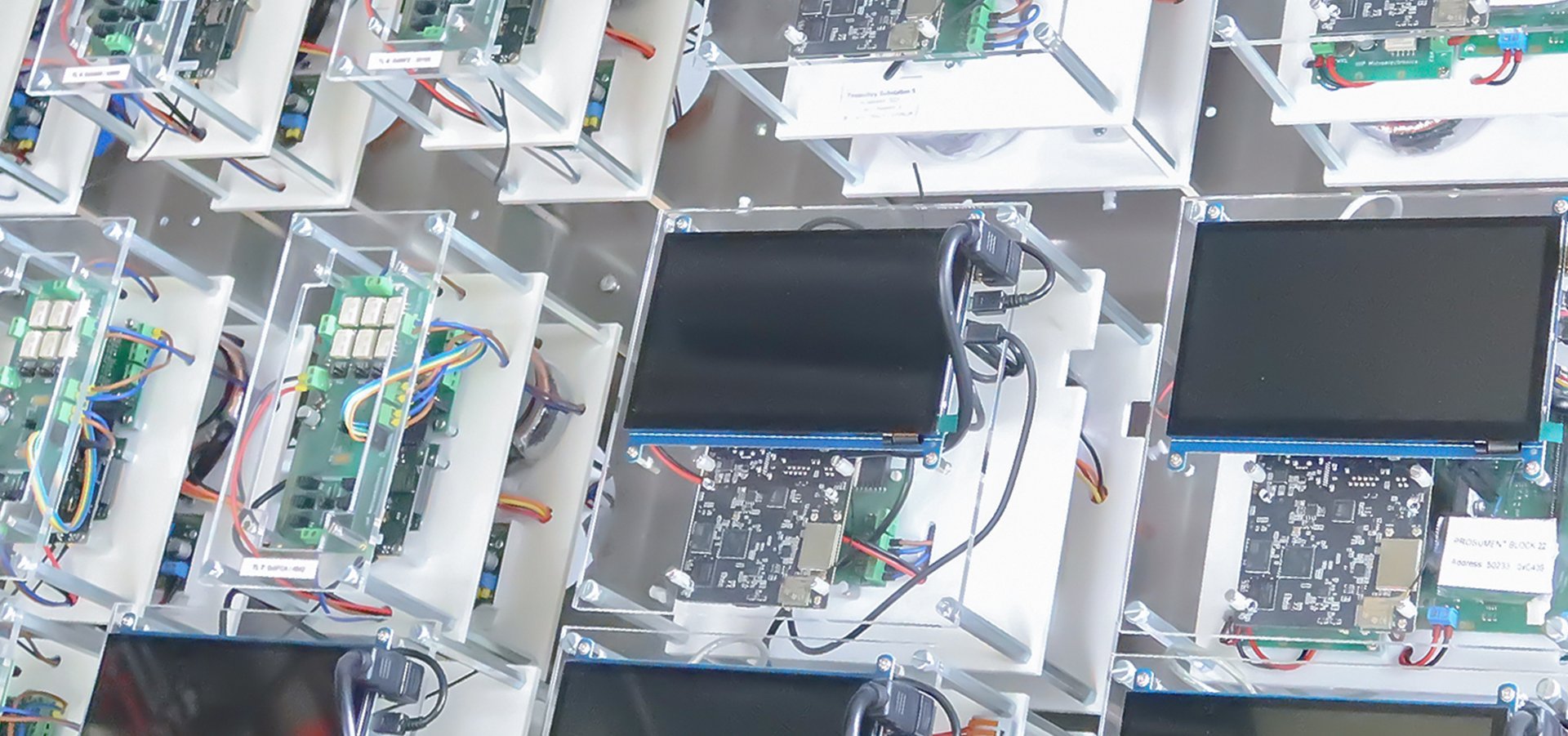
The Intelligent IoT Systems (IIoTS) working group addresses the fundamental challenges of designing trustworthy, adaptive, and interoperable cyber-physical systems (CPS) for increasingly digitalized environments. As modern industrial and societal systems generate vast amounts of heterogeneous data across distributed infrastructures, new approaches are required to transform this data into actionable knowledge while ensuring efficiency, scalability, and resilience. IIoTS investigates architectures, methods, and technologies that enable cyber-physical systems to continuously observe their environment, reason about their operational state, and autonomously adapt their behaviour through data-driven feedback loops.
A central research challenge is the realization of distributed intelligence across the computing continuum – from resource-constrained edge devices to cloud platforms – while maintaining interoperability, reliability, security, and energy efficiency. As such, we develop scientific foundations and engineering methods that enable modular, reusable, and semantically interoperable IoT solutions, supporting the development of cyber-physical systems of systems capable of evolving throughout their operational lifetime.
Research relevance and application areas
The growing complexity of digital ecosystems calls for cyber-physical systems that seamlessly exchange information, integrate diverse technologies and adapt autonomously to changing conditions. These capabilities are essential for the next generation of industrial automation, smart manufacturing, intelligent infrastructure, energy systems, healthcare and other data-intensive fields. IIoTS supports this transformation by developing methods that enhance the robustness, adaptability and interoperability of distributed IoT systems throughout their lifecycle.
Beyond enabling reliable data acquisition and processing, our research addresses the semantic integration of heterogeneous data sources, trustworthy distributed decision-making, and efficient deployment of computation across edge-cloud infrastructures. These capabilities provide the foundation for advanced applications such as digital twins, distributed monitoring and control, predictive system optimisation, and cross-domain data sharing.
Main research objectives
Intelligent Cyber-Physical Systems
Investigate data-driven approaches for autonomous monitoring, control, and optimisation of cyber-physical systems.
Develop architectures for distributed intelligence across edge, fog, and cloud infrastructures.
Enable adaptive and resilient cyber-physical systems capable of responding to dynamic operating conditions.
Modular and Adaptive IoT Architectures
Develop modular system architectures that improve scalability, maintainability, and reusability.
Investigate methods for dynamic deployment and reconfiguration of software and hardware components.
Develop engineering methodologies and tools for efficient development of distributed IoT applications.
Interoperability and Semantic Data Integration
Advance semantic interoperability between heterogeneous systems and application domains.
Develop ontology-based approaches for machine-interpretable data exchange.
Enable data reuse, data fusion, and application-independent information management.
Trustworthy Distributed Systems
Develop formal methods for modelling, verification, and analysis of distributed cyber-physical systems.
Investigate digital twins as virtual representations supporting system design and operation.
Improve reliability, data consistency, cybersecurity, privacy, and energy efficiency in distributed measurement and control systems.
Research areas
Intelligent Distributed Cyber-Physical Systems
This research area investigates how distributed cyber-physical systems can autonomously perceive, analyse, and respond to changes in their environment. The focus is on architectures and algorithms that enable intelligent control and optimisation across the computing continuum.
Modular IoT Software and System Engineering
IIoTS develops methodologies for designing modular and configurable IoT systems that can evolve with changing application requirements. Research focuses on reusable software and hardware components, flexible deployment strategies, and engineering tools that simplify the development of complex distributed systems.
Semantic Interoperability and Distributed Data Management
This research area addresses one of the key barriers to large-scale digital transformation: the seamless integration of heterogeneous systems. Here we develop semantic models, ontologies, and interoperable communication mechanisms that enable meaningful information exchange, data fusion, and cross-domain collaboration.
Digital Twins and Trustworthy IoT Systems
In this research area, we investigate methods for ensuring that distributed cyber-physical systems remain reliable, secure, and energy-efficient throughout their lifecycle. Research combines formal modelling, digital twins, system verification, and runtime analysis to support trustworthy operation under changing conditions.
Projects
The IIoTS research projects present a coherent research strategy around distributed intelligent systems, spanning the entire sensing-to-decision pipeline: intelligent sensors → edge AI → interoperable IoT platforms → multi-source data fusion → trustworthy decision support for cyber-physical systems.
-
SmartRiver2 – Cross-border Intelligent Environmental Monitoring for the Oder Region (EU INTERREG) >> click here <<
SmartRiver2 is an INTERREG cross-border research project that builds on the results of the original SmartRiver initiative to develop an intelligent monitoring platform for the Oder river area. The project integrates distributed sensor networks, IoT technologies, and data analytics to support flood risk management, environmental monitoring, and climate adaptation in the Frankfurt (Oder)–Słubice region. The IIoTS group contributes to methods for distributed data acquisition, interoperable IoT architectures, and intelligent data processing that enable reliable environmental monitoring and data-driven decision support. Beyond flood protection, the developed platform serves as a foundation for broader Smart City applications and cross-border digital services.
More information: https://www.ihp-microelectronics.com/research/trustworthy-systems-of-systems/projects/smart-river
-
MobiRobAI – Modular AI-based Mobile Robotics for Autonomous Applications (EU INTERREG) >> click here <<
MobiRobAI is an INTERREG project that advances modular, AI-enabled robotic systems by transferring technologies originally developed for space robotics to terrestrial applications (in SpaceRegion project). The project develops an autonomous mobile manipulator capable of intelligent perception, navigation, and manipulation for applications such as precision agriculture and infrastructure maintenance. IIoTS contributes with expertise in AI-based image recognition, modular system architectures, and intelligent software integration, supporting the development of interoperable and reusable robotic components. By combining distributed intelligence, computer vision, and modular engineering approaches, the project establishes a foundation for adaptable autonomous robotic systems and strengthens the cross-border innovation ecosystem in robotics and artificial intelligence.
More information: https://www.mobirobai.spaceregion.eu/
-
AI-DISCO – Edge/Cloud AI for Distributed Sensing and Computing (DE BMFTR) >> click here <<
AI-DISCO is a flagship research project of the German Research and Innovation Factory for AI & Microelectronics (R+I Factory) that develops an open platform for energy-efficient, distributed artificial intelligence across the edge–cloud computing continuum. The project addresses key challenges in real-time data processing, including scalability, resilience, security, and energy consumption, by combining intelligent edge nodes with reconfigurable hardware, AI accelerators, neuromorphic computing concepts, and collaborative cloud services. As the consortium leader, IHP contributes to the development of novel edge AI architectures for distributed sensing and data processing technologies, where IIoTS advances methods for distributed data processing, interoperable system architectures, and intelligent IoT integration. The resulting platform enables trustworthy, low-latency AI applications for Industry 4.0, smart cities, energy systems, environmental monitoring, and critical infrastructure by processing data in an optimal way, e.g., as close as possible to where it is generated.
More information: https://www.ihp-microelectronics.com/news/detail/research-and-innovation-factory-for-ai-microelectronics-first-approved-module-ai-disco-begins-work
-
InSeKT – Development of Intelligent Sensor-Edge Technologies (DE MWFK) >> click here <<
InSeKT is a collaborative research project that develops intelligent sensor-edge technologies for real-time, AI-driven data processing directly at the point of data acquisition. The project addresses the challenge of moving artificial intelligence from centralized cloud infrastructures to resource-constrained edge devices, enabling faster response times, reduced communication overhead, improved privacy, and enhanced resilience. Together with the Technical University of Applied Sciences Wildau and Fraunhofer IPMS, IHP and IIoTS contributes to methods for edge AI, distributed data processing, and intelligent IoT system integration. By combining advanced sensor technologies with energy-efficient AI algorithms and interoperable edge architectures, the project establishes the foundations for next-generation intelligent sensing systems with applications in industrial electronics, medical technology, and environmental monitoring.
More information: https://www.ipms.fraunhofer.de/en/applications/Trusted-Electronics/InSeKT.html
-
SensorNet – Intelligent Sensor Networks for Personal Health and Environmental Monitoring (EU INTERREG) >> click here <<
SensorNet is an INTERREG cross-border research project that develops an intelligent sensor network for real-time monitoring of personal health and environmental conditions in safety-critical applications. The project addresses the challenge of continuously assessing both physiological parameters and environmental hazards—including harmful gases, temperature, humidity, atmospheric pressure, and noise—and transforming these heterogeneous data into actionable information. By integrating distributed sensing, edge intelligence, artificial intelligence, and interoperable communication technologies, the project enables early detection of hazardous situations and supports timely intervention for personnel operating in extreme environments. IIoTS contributes expertise in intelligent IoT architectures, distributed sensor systems, edge data processing, and AI-based data analytics for adaptive health and environmental monitoring. A key innovation of the project is the development of an intelligent monitoring platform that combines real-time sensor networks with personalized AI models capable of identifying deviations from individual baseline conditions and autonomously triggering alerts. The resulting solution provides a scalable and interoperable platform for health and safety monitoring with application potential in emergency response, healthcare, industry, civil protection, and future space missions.
-
SpectralRiver – Intelligent Remote Sensing for Cross-Border Water Quality Monitoring (EU INTERREG) >> click here <<
SpectralRiver is an INTERREG cross-border research project that develops an intelligent environmental monitoring system for assessing water quality in the Oder river using satellite, drone, and in-situ sensing technologies. The project addresses the challenge of providing timely, comprehensive, and reliable detection of ecological hazards, such as harmful algal blooms, by integrating heterogeneous observation data into a unified monitoring and decision-support platform. Triggered by the 2022 ecological disaster in the Oder river, the project aims to strengthen cross-border environmental protection through advanced remote sensing and data-driven monitoring approaches. IIoTS contributes expertise in interoperable IoT platforms, distributed data management, and intelligent information systems by extending the existing SmartRiver platform with remote sensing capabilities. The project combines spectral image analysis with ground-based measurements to enable multi-source data fusion, continuous environmental monitoring, and transparent reporting of water quality indicators. The resulting platform supports environmental authorities with early warning capabilities and provides a scalable framework for resilient, cross-border management of river ecosystems under the growing impacts of climate change.
Together, these projects showcase IIoTS's expertise across the entire edge-to-cloud continuum, from intelligent sensors and edge AI to interoperable distributed systems and application-specific cyber-physical solutions. The group is also contributing to standardization activities (DKE, IEC, CEN/CENELEC).