


Analog-to-digital and digital-to-analog conversions are the processes that nowadays take place in any electronic system, connecting analog and digital worlds. The Data Converters & High-Speed Logic Circuits Group focus on research and development of integrated circuits for analog-to-digital and digital-to-analog conversion, together with the mixed-signal functions required in various application areas. Its research spans a particularly broad performance range: from ultra-low-power data converters for neuromorphic and sensor interfaces to extremely high-speed data converters for future wireless and wireline communication systems. Depending on the application, the group uses IHP 130 nm SiGe BiCMOS technologies for maximum speed and bandwidth, as well as advanced nanometer-scale CMOS processes for highly integrated and energy-efficient implementations.
Research Relevance and Application Areas
The focus is on the development and implementation of high-speed data converters and possible system integration in wireless or wireline transceivers. This is relevant for 6G communication, where we developed a high-speed IQ baseband DAC for a D-band transmitter covering 30 GHz instantaneous bandwidth. For the wireline application, current research focuses on the development of alternative PAM signal generation architectures targeting more than 200 Gb/s datarates.
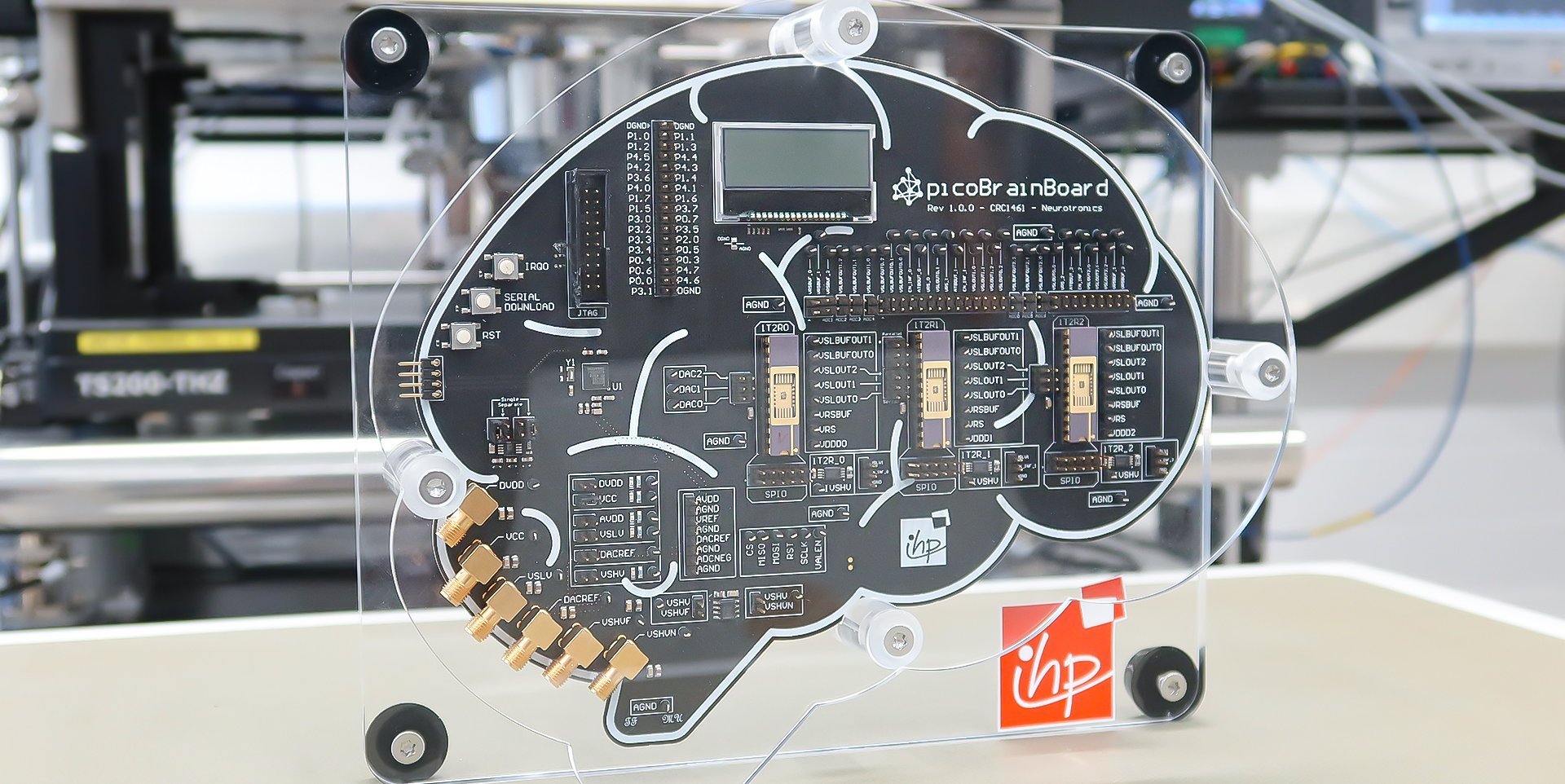
In both areas of applications, the aim is to maximize the bandwidth (data rate) and energy efficiency. On the other hand, the group contributes to research on an energy-efficient AI hardware accelerator. Recent development of RRAM-based analog neural network inspired the group for further research on energy-efficient analog in-memory computing solutions, which are highly relevant for edge computing applications.
Main Research Objectives
Improving high-speed ADC/DAC performance
- exploring circuit solutions to extend the bandwidth of operation
- targeting higher conversion accuracy
- focusing on energy efficient operation
Research on alternative transmitter architectures
- exploring mixed-signal transmitters
- targeting broadband operation
Analog in-memory computing
- developing new approaches for vector-matrix multiplication (VMM)
- focusing on energy efficiency
- developing analog VMM accelerators compatible with digital design flows
Research Areas
Energy efficient ADC and DACs
ADC and DAC research focuses on optimization of the interface between real-world signals and digital computers. ADCs digitize real-world signals into digital data for processing, whereas DACs perform the reverse operation by converting digital data into physical outputs. Current research aims to improve their speed, accuracy and energy efficiency while reducing hardware size and cost. These technologies are especially important in applications such as AI hardware, wireless and wireline communications, medical devices, and edge computing.
Analog in-memory computing
Modern AI research targets scalable applications, ranging from large language models in data centers to real-time computer vision on edge devices, all of which require highly efficient computing. These complex deep learning models are based on neural network layers that perform vector-matrix multiplication (VMM) operations. Since VMM operations account for approximately 80–90% of the overall computational workload, developing fast and energy-efficient VMM accelerators is of great importance. Analog in-memory computing (AIMC) addresses these challenges by performing mathematical computations directly within memory, thereby reducing the need to transfer data between memory and the CPU. Moreover, AIMC exploits fundamental physical laws to perform multiplication and addition operations in the analog domain, potentially reducing energy consumption compared with fully digital solutions.