


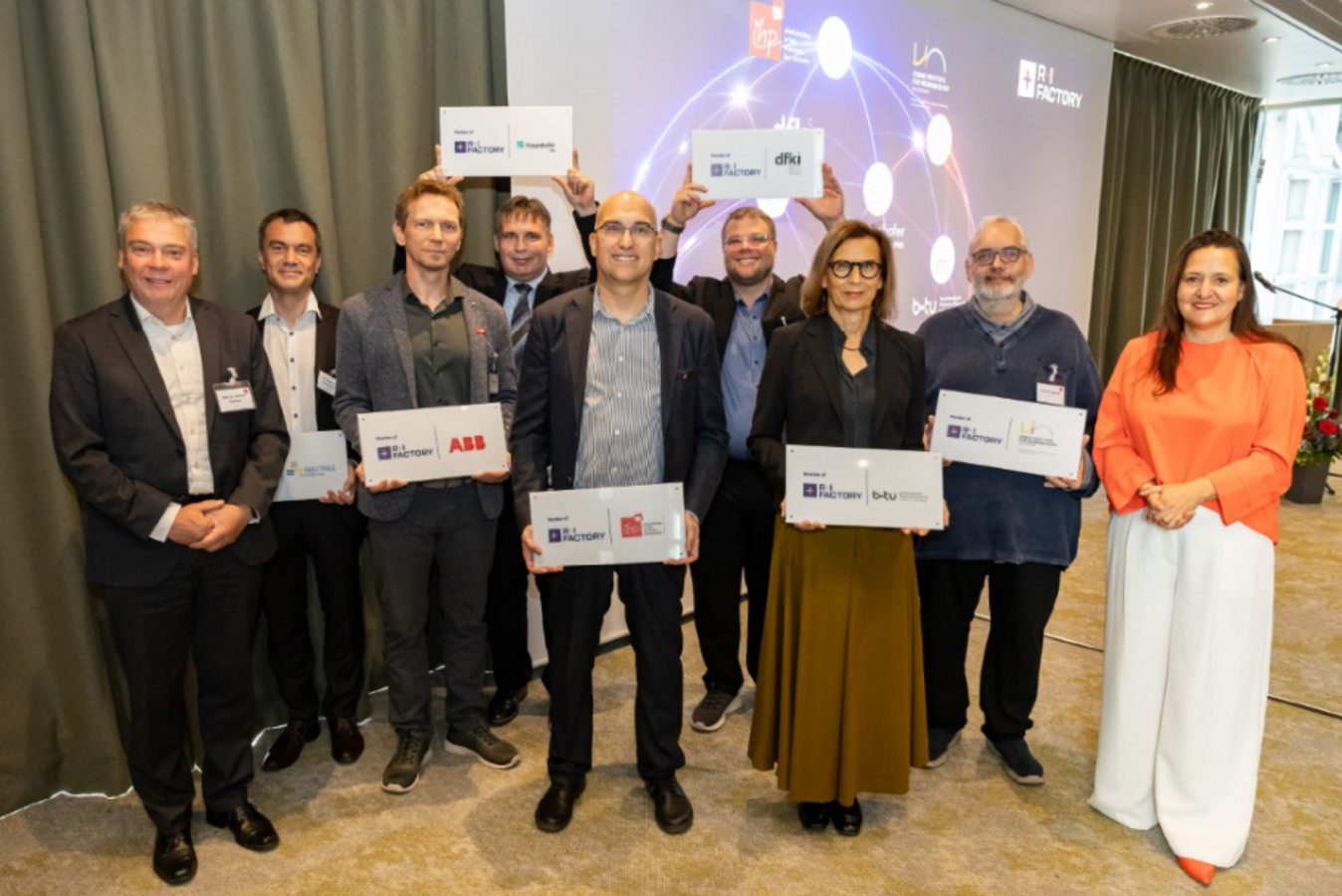
Cottbus, 14 September 2026. The Research and Innovation Factory AI & Microelectronics was officially inaugurated in Cottbus today, establishing a long-term framework for research into artificial intelligence (AI) and microelectronics. The initiative begins with AI-DISCO, its first approved module, which has been running since February 2026. Seven partners from research and industry are working together until early 2030 to investigate a platform for energy-efficient, distributed AI processing. The German Federal Ministry of Research, Technology and Space (BMFTR) is providing €15 million in funding for AI-DISCO under the Structural Development Act. The consortium is led by IHP - Leibniz Institute for High Performance Microelectronics.
Dorothee Bär, Federal Minister of Research, Technology and Space, explains the significance of the initiative for Germany as a technology location:
"Here in Cottbus, a model for modern technology policy is taking shape. The Research and Innovation Factory will build long-term expertise in artificial intelligence and microelectronics—from Industry 4.0 to medicine—and thus make an important contribution to the technological sovereignty of Germany and Europe. With its first module, AI-DISCO, the initiative is researching ways to use AI across decentralised, interconnected nodes rather than relying on large-scale computing systems. This combines technological progress with structural development: the funding strengthens Lusatia as a centre of innovation while simultaneously building strategic capabilities for Germany as an industrial location. Initiatives such as this demonstrate how our High-Tech Agenda Germany is being put into practice. By developing our own energy-efficient AI chips, we aim to consolidate Germany's position as the number one location for chip manufacturing."
Brandenburg's Minister of Science, Research and Culture, Dr. Manja Schüle, officially inaugurated the initiative together with Prof. Dr.-Ing. Gerhard Kahmen, Scientific and Technical Director of IHP. For the state of Brandenburg, the initiative also represents a contribution to structural transformation in Lusatia:
"With AI-DISCO, something is taking shape in Cottbus that goes far beyond a single research project. The project aims to combine artificial intelligence and microelectronics and develop sensors capable of performing computations themselves. This makes industrial systems faster, more energy-efficient and less dependent on remote data centres. What I find particularly exciting is that the researchers are focusing on neuromorphic computing—in other words, chips inspired by the way our brains work. We are deliberately investing in cutting-edge research and high technology as drivers of structural transformation in Lusatia. What is being established here is not simply a consolation prize for a former coal-mining region. It is a location where tomorrow's technologies are being developed—with European ambitions. If sensors are able to think independently in the future, people should know where they learnt to do so: in Lusatia."
Prof. Dr.-Ing. Gerhard Kahmen explains what the initiative means for Cottbus as a research and development location:
"Bringing microelectronics and artificial intelligence together opens up applications that neither discipline could achieve on its own—in manufacturing, in edge-cloud systems and in chip design itself. To make this possible, we are pooling our expertise within the R+I Factory. With its research focus, the R+I Factory makes an important contribution to further strengthening the profile and visibility of Cottbus as a research and development location."
Specifically, the partners are investigating edge nodes that use AI processing based on neuromorphic circuits inspired by findings from neurobiology. The research also covers federated learning approaches in which the cloud pre-trains the nodes rather than collecting all the data centrally, as well as the security and resilience of distributed systems. Since the nodes often operate on batteries, energy is the most limited resource.
The technologies are being tested across several application areas. In energy systems, spatially distributed sensors are intended to detect operational anomalies in wind turbines and solar installations at an earlier stage, without requiring all measurement data to be transferred to a data centre. Other application areas include Industry 4.0, medical technology and agriculture, 6G communications, as well as smart cities and critical infrastructure.
ABB illustrates the benefits expected by the industrial partners using the example of automation technology:
"In automation, decisions have to be made in fractions of a second. If the data is only processed in a data centre, the results arrive too late. That is why we are particularly interested in AI-DISCO's approach of performing AI computations directly within the industrial equipment."
Dr. Martin Handreg, Automation Manager, ABB
The initiative also brings new research expertise to Cottbus. As part of AI-DISCO, two research institutions are joining the location: the Leibniz Institute for Neurobiology (LIN) and the German Research Center for Artificial Intelligence (DFKI). At the same time, the R+I Factory is expanding the cooperation network surrounding the Lusatia Science Park and Brandenburg University of Technology Cottbus-Senftenberg, whose President, Prof. Dr. Gesine Grande, spoke at the launch event.
The consortium comprises IHP - Leibniz Institute for High Performance Microelectronics as consortium leader, Brandenburg University of Technology Cottbus-Senftenberg, the German Research Center for Artificial Intelligence (DFKI), the Fraunhofer Institute for Photonic Microsystems IPMS, the Leibniz Institute for Neurobiology (LIN), and the companies ABB and ENERTRAG.
