


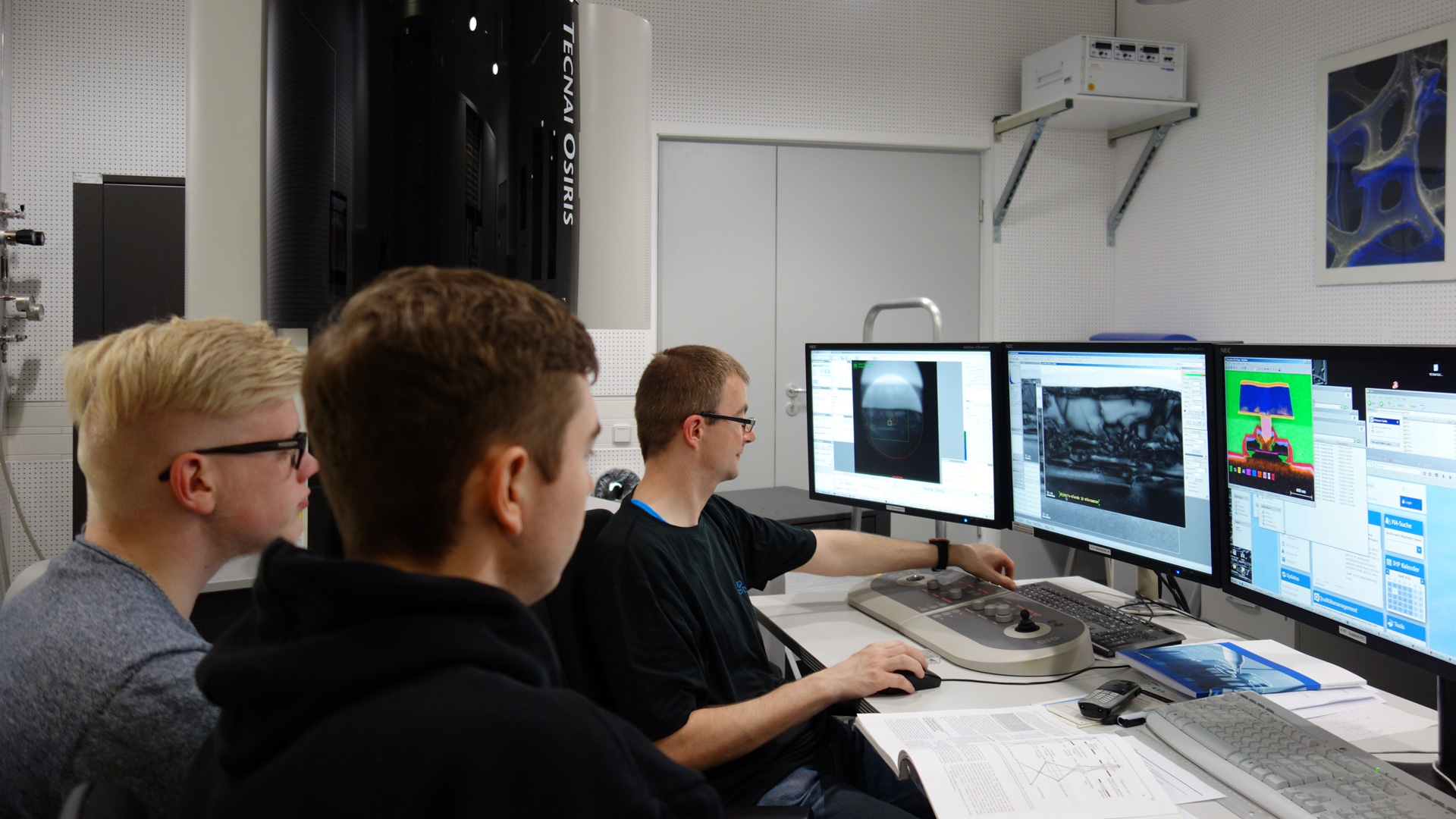
The Joint Lab “Photonic Devices and Thin Film Technologies” brings together TH Wildau and IHP to advance hybrid photonic devices, modules and thin-film technologies for sensor, medical and More-than-Moore applications.
Founded in 2006, the Joint Lab has focused since 2016 on the development and realization of hybrid photonic modules. Alongside research, the cooperation places strong emphasis on academic teaching and the joint training of young scientists and engineers.
In 2026, the Joint Lab celebrated 20 years of existence. Read more about its achievements in the official press release.
-
Research >> click here <<
The Joint Lab develops hybrid photonic devices, modules and technologies, with a particular focus on applications in sensor technology and medical technology. Its research also includes process and technology development for graphene-based devices.
Within IHP’s More-than-Moore device and technology development, the Joint Lab researches new diagnostic approaches for the photonic modules under development.
Cooperation, Teaching and Transfer
The Joint Lab strengthens the long-standing cooperation between TH Wildau and IHP through joint research, teaching, networking and public outreach.
Academic teaching and research are continuously developed through lectures, laboratory internships, student excursions and joint dual study programmes for students in TH Wildau’s bachelor’s and master’s degree programmes. Numerous bachelor’s and master’s theses reflect the sustained success of the cooperation.
Research results are presented through public events and professional forums, including Wildau Science Week, Sensor & Test and the Microsystems Technology Congress.
A special highlight was the international summer school held in 2018, organized by TH Wildau in cooperation with the University of Rome Tor Vergata and IHP.
-
Projects >> click here <<
OptiPlat
Optimization of a plasmonic-photonic technology platform for the detection of inflammatory markers in blood
The goal is to optimize plasmonic-photonics sensors for the detection of biomolecules in peripheral blood through improved microchip manufacturing processes and AI-supported data analysis methods. Optimizing existing technological capabilities also enables their transfer to cross-cluster applications such as environmental monitoring, food analysis, and water analysis.
The project is co-funded by the Brandenburg State, MWFK, EFRE and StaF-Verbund. It runs between July 2024 and June 2028.
CoLuM
Monolithic co-integration of luminescence detectors with photonic immunosensors for multiplexing biomarkers in complex sample matrices
CoLuM aims to develop a novel hybrid photonic sensor chip that combines two complementary detection methods—highly sensitive luminescence detection and refractive index-sensitive methods. The project addresses a key challenge in bioanalytics: the simultaneous, highly sensitive detection of multiple biomarkers in complex sample matrices.
Quantum Gyro
Quantum-optical gyroscope in a SiN-on-SOI hybrid platform
The main goal of the “QuantumGyro” project is to develop a hybrid manufacturing platform for novel quantum-optical gyroscopes that are both compact and cost-effective. In this project, TH Wildau is focusing on the development and validation of a functional design for quantum-optical gyroscopes, while the Leibniz IHP is providing the process platform for manufacturing the functional prototypes.
The project is funded by BMFTR and runs between May 2025 and April 2028.
GreenICT (completed)
Green Information and Communication Technology
The project Green ICT focused on energy- and resource-efficient information and communication technologies, addressing the environmental footprint of digital hardware across development, production, application, and use.
BioPIC (completed)
Integration of Biosensors based on Photonic Integrated Circuits by Local-Backside Etching
In BioPIC applied basic research was conducted on photonic sensors to support faster heart attack diagnosis in emergency medical care.
HOPBIT (completed)
Hybrid Silicon-Organic Photonics for High-Bit-Rate Data Transmission
HOPBIT focused the development of a technology platform for integrating photonic silicon-organic hybrid (SOH) devices into silicon-based chip technology.
GETiT (completed)
Graphene Exfoliation – Technology Development of an Industry-oriented 2D Transfer Process
GETiT focused on graphene exfoliation and the development of an industry-oriented 2D transfer process.
DoGeALD (completed)
Doping of Ge and SiGe from Dopant-Containing ALD-Deposited Layers
The DoGeALD DFG project investigates ultra-thin-film doping using atomic layer deposition and flash-lamp annealing in patterned germanium structures for future 3D electronic and photonic devices. IHP contributes test-template fabrication and material characterization.
-
Publications >> click here <<
2026
Monolithically Integrated Optical Through-Silicon Waveguides for 3D Chip-to-Chip Photonic Interconnects
F. Villasmunta et al.,
in IEEE Journal of Selected Topics in Quantum Electronics, vol. 32, no. 2: 3-D Horizons in Photonics: Integrated Circuits, pp. 1-15, March-April 2026, Art no. 3700215, doi: 10.1109/JSTQE.2025.3615001.
2025
Reflectometric Method for Measuring Residual Oxides in Through-Silicon Vias for 3D Chip Integration
Bauer, F. Heinrich, F. Villasmunta, C. Villringer, J. Reck, S. Peters, A. Treffer, C. Kuhnt, St. Marschmeyer, O. Fursenko, D. Stolarek, A. Mai, M. Regehly,
in Optics Express 33(15), 32175 (2025)
Towards Monolithic Integration of Polymer-based Electro-Optical Devices in Silicon Photonic Integrated Circuits using a 250nm SOI Technology
Steglich, M. Paul, T. Fünning, C. Schumann, Ch. Mai, R. Tannenberg, A. Mai,
in Proc. SPIE Optics + Optoelectronics (2025), 13530, 135300R (2025)
Optimization of Local Backside Released Micro-Ring Resonators for Sensing Applications using Silicon Photonic Integrated Circuits in an SOI Technology
Fünning, A. Peczek, A. Kroh, Ch. Mai, M. Paul, F. Thomsen, R. Tannenberg, C. Schumann, M.G. Weller, A. Mai, P. Steglich
in Proc. SPIE Optics + Optoelectronics (2025), 13527, 135270U (2025)
2020
Back-Side Release of Slot Waveguides for the Integration of Functional Materials in a Silicon Photonic Technology With a Full BEOL
C. Mai, P. Steglich, M. Fraschke and A. Mai,
in IEEE Transactions on Components, Packaging and Manufacturing Technology, vol. 10, no. 9, pp. 1569-1574, Sept. 2020, doi: 10.1109/TCPMT.2020.3011149.
2019
Silicon-Organic Hybrid Photonics: Integration of Electro-Optical Polymers in a Photonic Integrated Circuit Technology
P. Steglich, Ch. Mai, C. Villringer, B. Dietzel, S. Schrader, A. Mai,
in ECS Transactions 92(4), 187 (2019).
Photonic Thermal Sensor Integration Towards Electronic-Photonic-IC Technologies
A. Mai, S. Bondarenko, Ch. Mai, P. Steglich,
in Proc. 49th European Solid-State Device Research Conference (ESSDERC 2019), 254 (2019).
Diagnostic of Graphene on 200 mm Ge(100)/Si(100) Wafers by Spectroscopic Ellipsometry
O. Fursenko, M. Lukosius, J. Bauer, C. Villringer, M. Fraschke, M. Lisker, A. Mai,
in Proc. 8th International Conference on Spectroscopic Ellipsometry (ICSE 2019).
2018
Silicon-on-Insulator Slot Waveguides: Theory and Applications in Electro-Optics and Optical Sensing
P. Steglich,
in Emerging Waveguide Technology, 1st Edition, Editor: K.Y. You, Chapter 10. Silicon-on-Insulator Slot Waveguides: Theory and Applications in Electro-Optics and Optical Sensing, IntechOpen, 187 (2018).
-
Education >> click here <<
Further Information: