


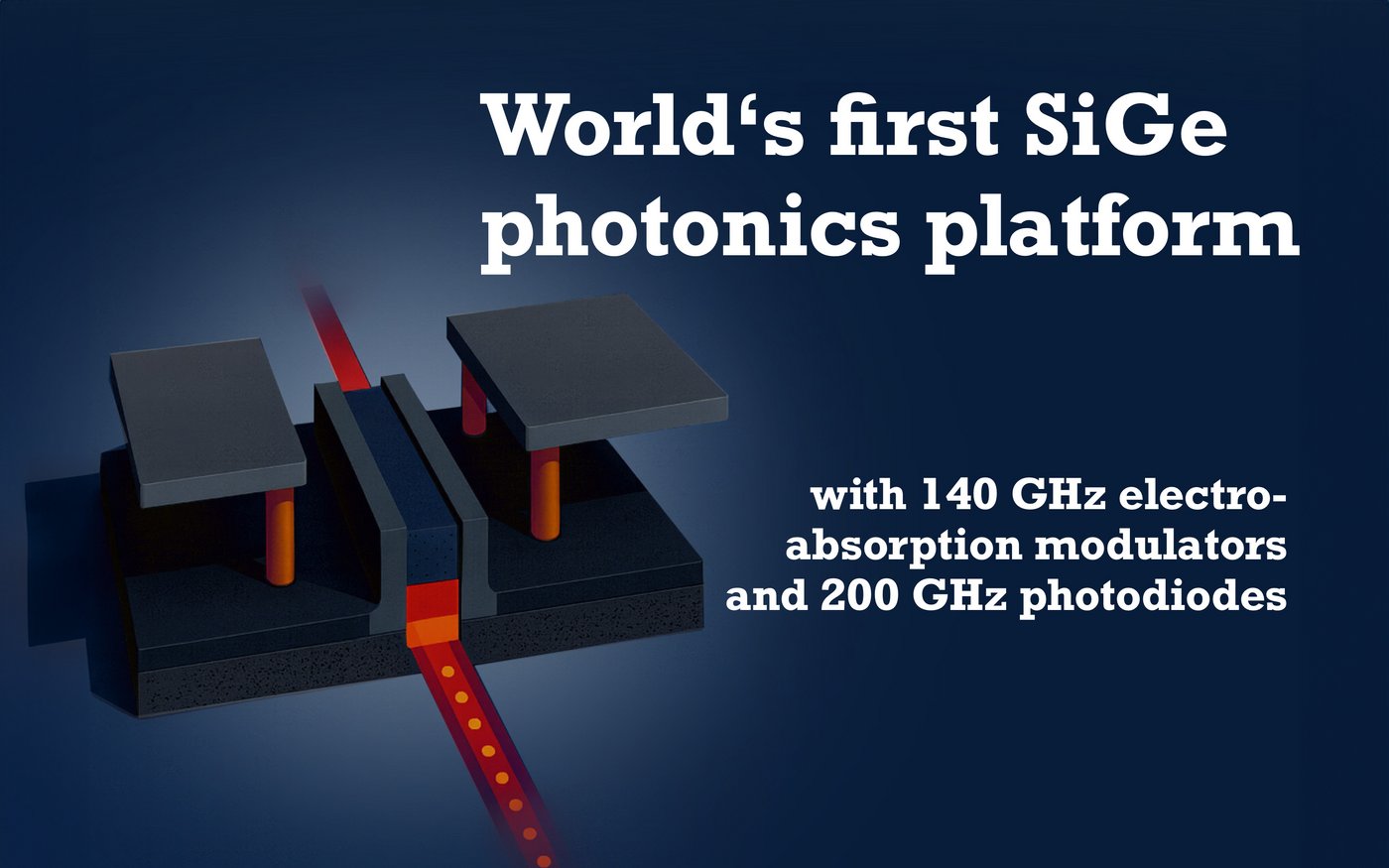
The relentless growth of data-heavy artificial intelligence (AI) compute clusters is accelerating the development of silicon photonics for high-speed optical interconnects. However, today’s platforms often hit bandwidth limits because they rely on Mach–Zehnder or ring modulators. Researchers at IHP – Leibniz Institute for High Performance Microelectronics – have now demonstrated the world’s first silicon–germanium (SiGe) photonics platform that overcomes these bottlenecks.
IHP has developed a novel SiGe photonics platform that enables optoelectronic devices with bandwidths far beyond those of current silicon-photonics solutions. The work demonstrates electro-absorption modulators with an extrapolated 3-dB cut-off frequency of 140 GHz and fin-photodiodes with extrapolated bandwidths up to 200 GHz. The results have been published in Nature Communications, with Daniel Steckler as first author. The open-access article can be accessed via the Nature Communications website: [https://www.nature.com/articles/s41467-025-66566-2].
“For a long time, full platform compatibility has been the major issue,” says Daniel Steckler. “High-speed modulator and detector demonstrations as stand-alone devices are commonplace. Our SiGe photonics platform allows us to fabricate electro-absorption modulators and photodiodes with cut-off frequencies well above 100 GHz in a single process flow – a basic requirement for beyond-200-Gbaud communication and true mass manufacturing.”
IHP already holds the world record in photodiode performance using the concept of germanium-fin detectors first reported in Nature Photonics in 2021. By extending this fin concept to SiGe structures, the researchers now realize high-speed optoelectronics for modulation and detection in the C-band. This requires a new approach to SiGe epitaxial growth, which has been developed at IHP.
“Our epitaxy team has developed an advanced SiGe growth technology that incorporates just the right amount of silicon into germanium to shift the absorption edge to the desired wavelength regime, while avoiding the loading effects that typically plague integrated SiGe devices,” explains Steckler. “This is achieved by a silicon delta-layer growth technology.”
On the modulator side, IHP has developed a compact, energy-efficient and high-speed waveguide-integrated SiGe electro-absorption modulator (EAM). Because the available instrumentation at IHP currently limits opto-electronic bandwidth measurements to 110 GHz, the 3-dB cut-off frequency of these devices is extrapolated to be about 140 GHz. For the receiver side, the fin-photodiode bandwidth can be scaled according to system specifications: photodiodes may achieve extrapolated bandwidths of 160 GHz with a responsivity of 0.8 A/W at 1550 nm, or 200 GHz with a responsivity of 0.5 A/W.
“The true test of our platform was a high-speed link experiment, where we used EAMs and photodiodes fabricated on the same wafer,” says Steckler. “These outstanding results are the outcome of long-term cross-team collaboration at IHP – from cleanroom operations and process research to process integration and silicon photonics.”
IHP researchers continue to optimize the SiGe platform and its devices. Next, the team plans to co-integrate the world’s first SiGe photonics platform with IHP’s state-of-the-art BiCMOS technologies and to offer SiGe platform services to customers worldwide, enabling ultra-fast and energy-efficient optical links for future AI and high-performance computing systems.
