


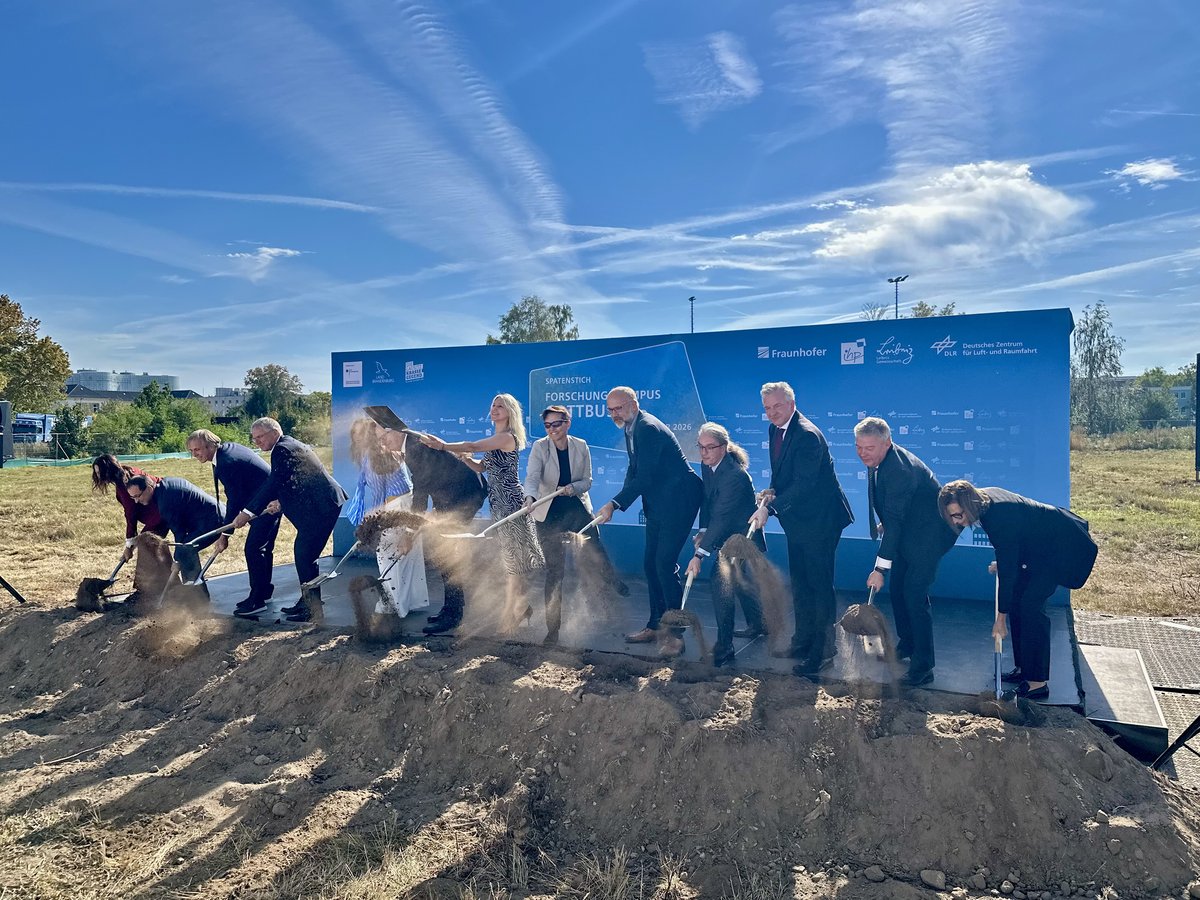
Cottbus / Frankfurt (Oder), 1 October 2026. With a joint ground-breaking ceremony, the German Aerospace Center (DLR), the Fraunhofer-Gesellschaft and IHP – Leibniz Institute for High Performance Microelectronics today marked the start of development work for the new research campus at Lausitz Science Park. Over the coming years, the three partners will each construct their own buildings on the 51,000-square-metre site. IHP is planning an office and laboratory building there that will serve as a Leibniz site and provide around 140 workplaces. Completion is scheduled for the end of 2029.
At its Cottbus site, IHP plans to focus on research topics that combine microelectronics, innovative material systems and artificial intelligence. In Cottbus, IHP will concentrate on Intelligent Edge Systems that combine microelectronics and AI, distributed sensor systems, and new material systems for sensing applications. The laboratories are intended for materials analysis, sensor technology and embedded systems, as well as biomaterials for healthcare applications. A further laboratory will be used to build systems and demonstrators. IHP will use half of the building for its own activities; the other half will be available to other institutes of the Leibniz Association as a permanent or project-based base. This will enable several institutes to conduct interdisciplinary research under one roof. Since 2023, IHP has already maintained its own site in Nordstraße in Cottbus, where it is building up its team until it moves into the new building.
IHP has been active in Cottbus since 1998, with joint professorships, a Joint Lab and a Joint Research Center at Brandenburg University of Technology Cottbus-Senftenberg (BTU). IHP is supporting the region’s structural transformation through its participation in the structural development projects iCampus, OASYS and AI-DISCO. The latter was initiated by IHP and is also led by the institute. At the future campus, IHP will be located directly next to BTU, DLR and Fraunhofer and will conduct joint research in line with the strategic research areas of BTU Cottbus-Senftenberg and Lausitz Science Park. For the region, the new site can create opportunities for further research institutions and companies, including those from outside the region.
“Many of the questions we are working on today can no longer be answered within a single discipline. Sensor systems for medical applications, for example, require microelectronics, materials research and AI to work together,” says Prof. Dr.-Ing. Gerhard Kahmen, Scientific and Technical Managing Director of IHP. “With the new building, we are bringing these disciplines together under one roof, directly next to BTU and our partners on the campus. The research we carry out here is intended to be applied in Lusatia and will provide important impetus for the region’s structural transformation.”
Development of the research campus is funded by the German Federal Government under the Structural Development Act for Coal Regions and co-financed by the State of Brandenburg.
