



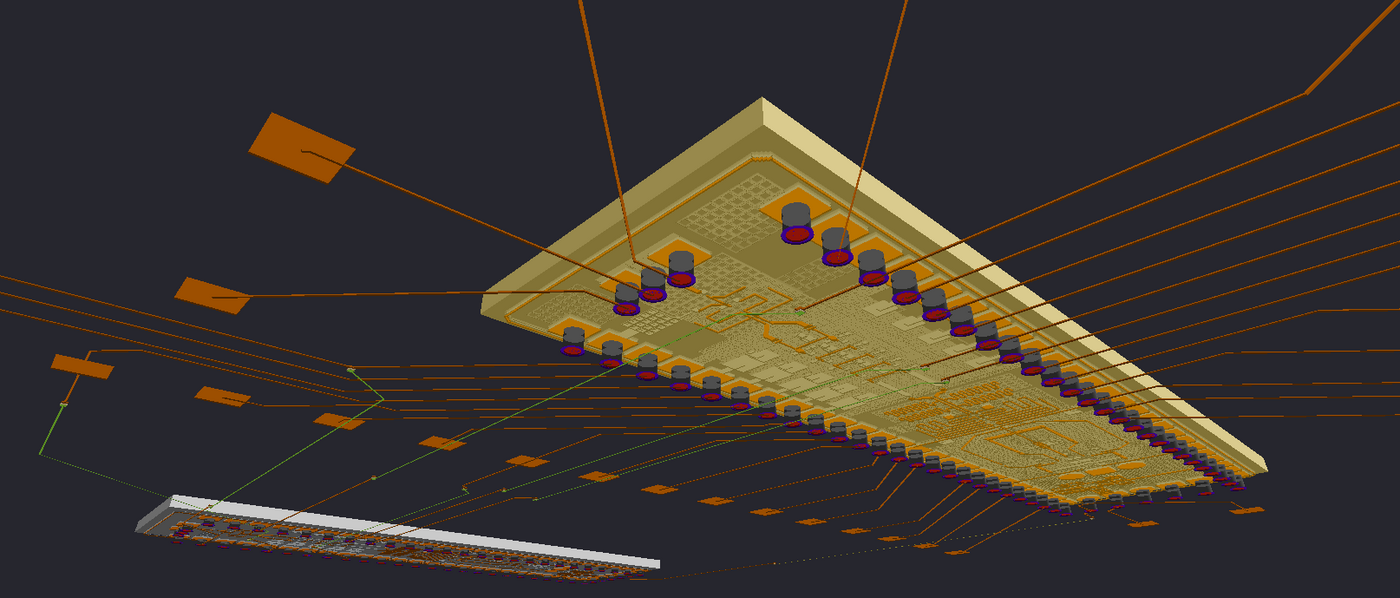
IHP - Leibniz Institute for High Performance Microelectronics today released the IHP Open ADK, the first European open-source Assembly Design Kit for heterogeneous chiplet systems with a real route to fabrication. Presented at the 2026 Free Silicon Conference in Ljubljana, the IHP Open ADK lowers the barriers to chip design and fabrication for researchers and start-ups.
For open-source microchip design, the launch marks an important milestone. While available open-source tools have made important progress in chip design, there has been no published open-source, end-to-end design kit for laying out a multi-chiplet 2.5D assembly on an interposer and verifying it against manufacturing rules. Commercial tools remain expensive, while open design tools are still in their infancy.
Unlike a concept or specification, the IHP Open ADK is open-source software, evolving end-to-end on an open foundry PDK. The ADK carries a permissive license, an open PDK, and no RAND or membership barrier – a collaborative, community-shaped development model rather than a closed standards process.
The software enables universities, start-ups and SMEs to design chiplet assemblies using an open design flow based on IHP's manufacturable open chip process (SG13G2), backed by IHP’s real, already-fabricated IntM4TM2 interposer technology.
The ADK lowers the barrier to entry into chiplet design – a field that is increasingly important for semiconductor innovation but still dominated by proprietary design systems. By publishing the IHP Open ADK as a shared research foundation, IHP invites researchers, universities, start-ups, SMEs, and the open-source community to test, extend, and help shape the emerging standards for heterointegrated microchip design.
Mauricio Montanares, Scientist at IHP and part of the ADK research team, commented on the milestone:
"Heterogeneous integration is still taking shape: many of the approaches and standards for 2.5D and 3D chiplet systems are not yet settled. Compared to monolithic chip design, where industry leads, here there is a genuine opening for the open-hardware community to study what already exists and shape the standards while they are being defined. We are putting the ADK out in the open so that conversation can start now. And to be clear, this is a research foundation we are sharing so others can help us build it out, not a finished product."
Why open chiplet design matters now
Open design infrastructure is becoming a strategic issue for Europe. Technological sovereignty depends not only on fabrication capacity, but also on the ability to understand, access and shape the design methods behind future semiconductor systems.
If advanced packaging and chiplet assembly remain limited to closed platforms, Europe risks narrowing participation in one of the most important technological shifts in semiconductor design. That would weaken the role of startups, SMEs and public research in a field that is increasingly central to innovation.
"The real challenge in heterogeneous integration isn't just connecting chiplets but co-designing them as one system. The Assembly Design Kit brings package awareness into early design, helping teams assess die partitioning, interconnect strategy, and packaging tradeoffs early in the flow thereby accelerating the transition towards heterogeneous chiplet-based systems. For me, contributing to this work means helping bridge the gap between open research and practical semiconductor design,” said Yegappan Sethu, Research Engineer at IHP
From open PDKs to open ADKs
The IHP Open ADK responds to a need identified in the Chip Design Germany roadmap, which calls on foundries to extend their Process Design Kits into Assembly Design Kits for 2.5D and 3D packaging.
Unlike open RTL-to-GDS flows, the IHP Open ADK does not design the chiplets themselves. Neither does it focus on vertical stacking, the domain of open 3D-IC flows. Its purpose is to connect everything into one open design flow: placing pre-existing dies, designing the interposer and interconnect, visualizing the assembly, and taking the result toward manufacturing-ready files.
Based on a survey of academic publications and openly available software projects, the researchers found no comparable open, end-to-end chiplet-assembly design kit tied to a manufacturable open chip process. While other teams, such as the US-based OpenROAD project, are rapidly advancing open tools in this space, the IHP Open ADK offers complementary capabilities. Above everything, it enables practical applications, by connecting the design process to a real, manufacturable chip and interposer process, with a route to fabrication.
To the researchers’ best knowledge, the release connects several first-of-their-kind elements:
an open Assembly Design Kit for 2.5D heterogeneous integration;
an open interposer design kit backed by a real route to manufacturing at IHP;
supporting tools for integration with circuit board software;
and tools for transforming designs into manufacturing-ready files.
The ADK's free, open 3D viewer shows the real, true-to-fabrication 3D shapes of the chiplet assembly. The accompanying “.chiplet” format provides an open, royalty-free way to describe assembly information and is intended to interoperate with existing industry formats. IHP is releasing the format without patent claims, so that the wider community can examine and contribute to it.
