


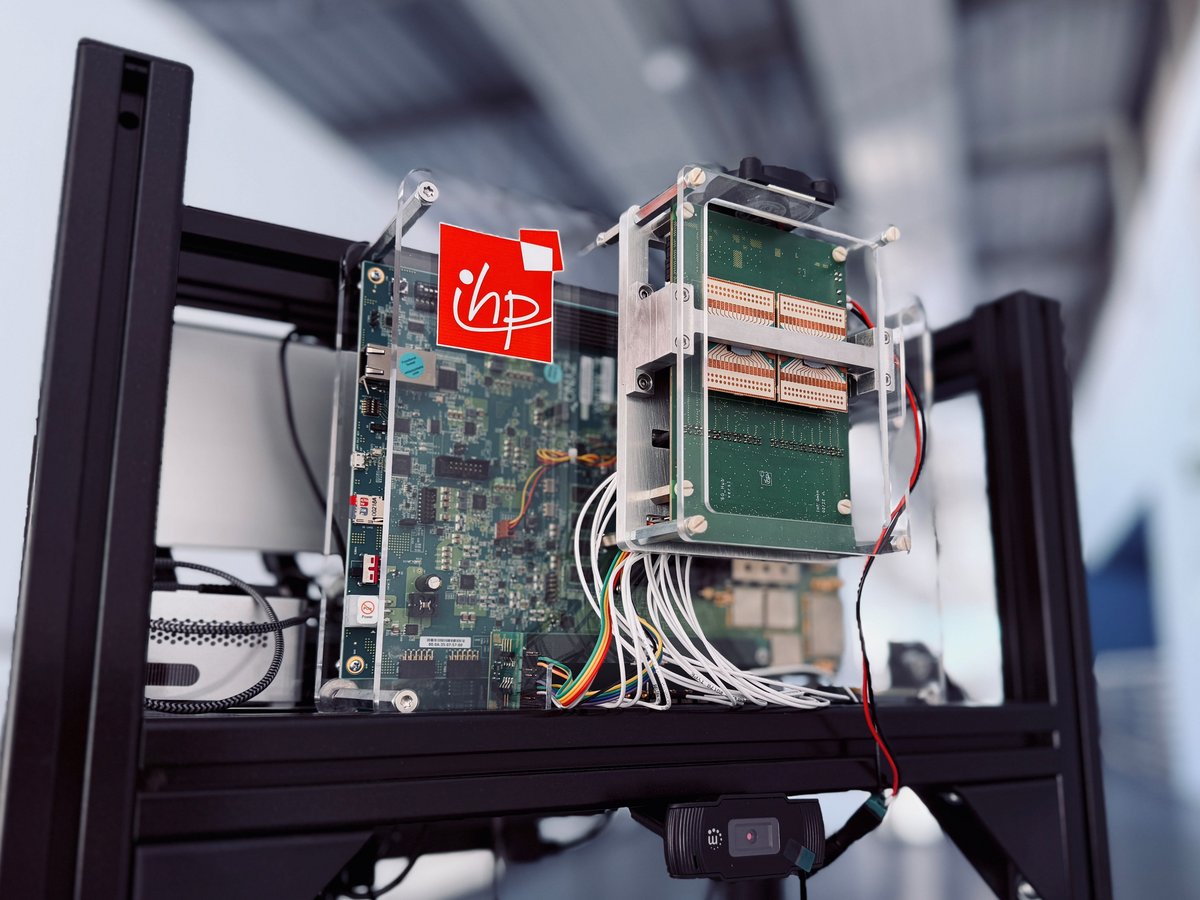
Fast radio connections can be sensitive if the direct line of sight between the transmitter and receiver is temporarily obstructed, for example by people, vehicles or buildings. In order to better address such challenges in the future, IHP – Leibniz Institute for High Performance Microelectronics is working on the xG-RIC project to further develop 6G technologies so that they can be transferred more quickly into applications for industry and society. On the occasion of the project kick-off on the 18th and 19th of February 2026, the institute is now announcing its first application-oriented live demonstration at the German Microwave Conference (GEMIC) in Karlsruhe.
The project “Technologie-Transfer-Hub für die Medizin und Mobilität der Zukunft” (xG-RIC) is designed as a central platform for technology transfer. Research, technology development and application-oriented innovation are to be closely interlinked, including in areas such as networked medicine and urban mobility, and in continuous exchange with industry partners, start-ups and other stakeholders. The aim is to advance key technologies for future 6G networks and systematically accelerate their transfer into practical environments. This includes proof-of-concepts (PoCs) as well as integration into realistic test environments, such as clinical settings.
IHP is presenting a concrete example of this approach at GEMIC 2026: high-frequency radio connections in the millimetre wave range enable very high data rates, but often require a direct line of sight. The planned demonstration will showcase a millimetre wave ICAS (Integrated Communication and Sensing) system in real-time operation. What makes it special is that the system can predict potential blockages using integrated environment detection, without the need for dedicated sensors or radar. This allows countermeasures to be taken at an early stage, for example by switching to alternative connections or suitable detour routes as a preventive measure.
“Data communication in the 60 GHz range usually requires a direct line of sight. With ‘Integrated Communication and Sensing – ICAS’, the system detects potential blockages at an early stage and can switch to a reflection detour path or an alternative connection as a preventive measure – thus ensuring stable communication,” explains Dr. Markus Petri, project manager of xG-RIC at IHP.
In addition to the demonstration, IHP is contributing to the further development of key technical components as part of xG-RIC. These include components for a fully digital transmitter in the FR3 range, a broadband D-band transceiver and signal processing approaches for next-generation MIMO. AI-supported approaches for network and edge intelligence are also being developed. The aim is to test these technologies at an early stage in realistic scenarios and prepare for their integration into future 6G networks. In doing so, IHP is preparing developments from initiatives such as Open6GHub and 6G Research and Innovation Cluster for further use.
xG-RIC is coordinated by the Fraunhofer Heinrich Hertz Institute. Other partners in the consortium are the Deutsches Herzzentrum Berlin (DHZB) at Charité, the German Aerospace Centre, Friedrich-Alexander University Erlangen-Nuremberg, the Fraunhofer Institute for Applied Solid State Physics, the Fraunhofer Institute for Integrated Circuits, the Technical University of Berlin and the TU Braunschweig. The project is funded by the Federal Ministry of Research, Technology and Space as part of the programme “Kommunikationssysteme – Souverän. Digital. Vernetzt”. The total project volume in phase 1 (1st of January 2026 to 30th of June 2028) amounts to €15.5 million, of which around €1.5 million is allocated to IHP. A second project phase until the end of 2029 is planned following a successful interim evaluation.
The next step is to further develop the ICAS system into a millimetre wave ICAS test bed that can be used by industry partners and start-ups in the future. In this way, IHP is helping to transfer innovative 6G technologies into practical applications at an early stage and further strengthen Germany's and Europe's technological sovereignty in the field of future communication systems.
