


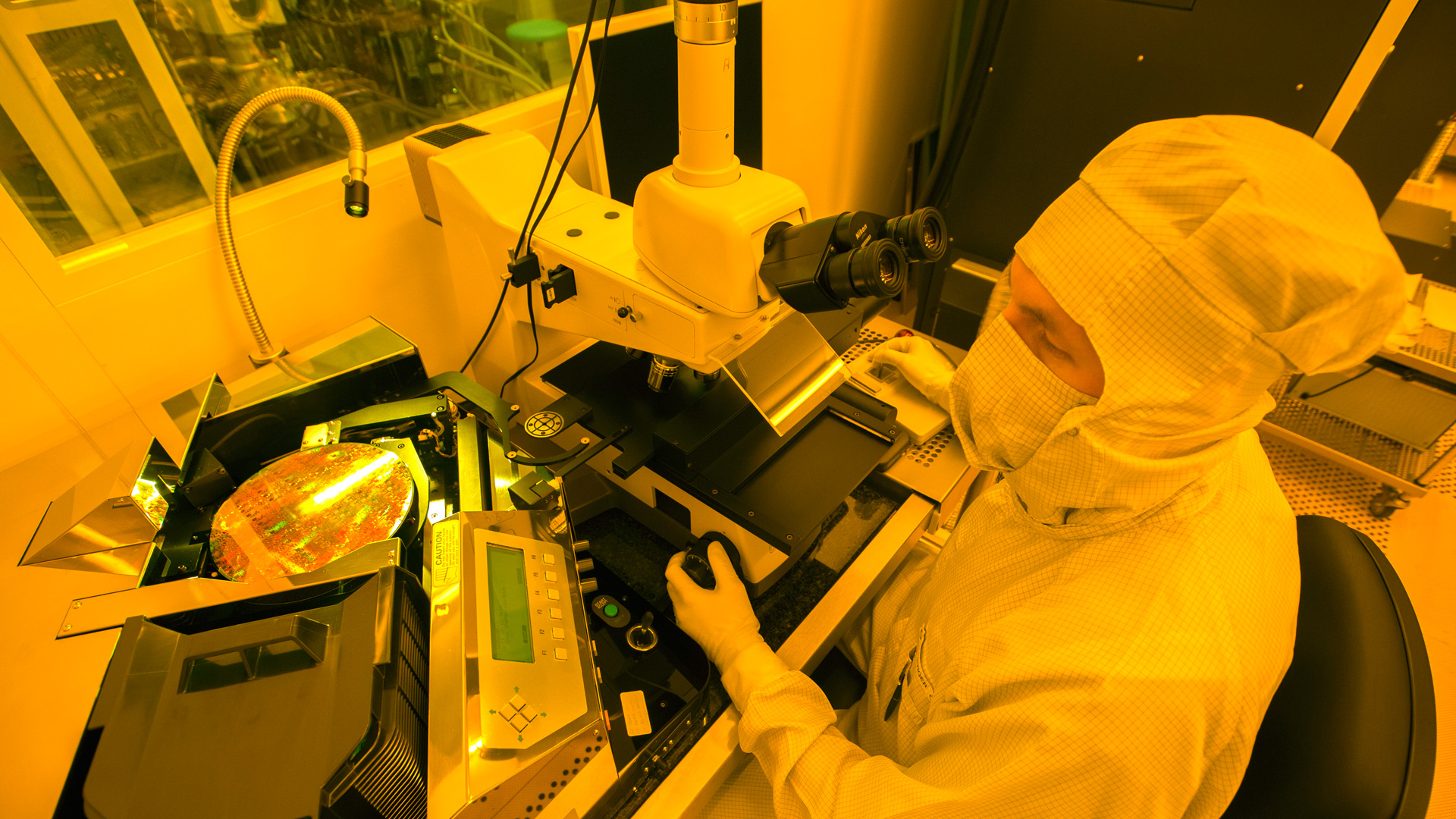
The research group Process Integration focuses on novel device concepts and fabrication technologies for silicon-based integrated circuits. Our activities target the development of high-frequency SiGe BiCMOS technologies and their extension towards emerging application areas, including monolithic electronic-photonic integrated circuits.
IHP’s clean room infrastructure and more than 250 m² of dedicated laboratory space enable the experienced team of scientists, engineers, and technicians to develop, test and validate new technologies. 13 semi- and fully automated 200 mm and 300 mm probe stations enable fast, flexible and efficient electrical on-wafer characterization for both internal research activities and external project partners.
Key Objectives in Technology Development
- Si-based process technologies for RF, THz, and optoelectronic applications
- High-speed SiGe heterojunction bipolar transistors (HBT) and BiCMOS integration
- Integration of optical components in SiGe-BiCMOS
Electrical Characterization Objectives
The Process Integration group develops and maintains the comprehensive electrical characterization capabilities for the IHP SiGe BiCMOS and ePIC technologies. Activities cover process monitoring, device and circuit characterization, modelling support, qualification, and reliability assessment.
- DC/CV characterization in cleanroom and laboratory environments
- S-parameter, RF-noise and LF-noise measurements
- Mixed-signal ASIC prototype and ESD testing
- On-wafer characterization of devices and circuits down to the cryogenic range (10K) for technology and compact model development
- Reliability testing (electromigration, dielectric breakdown, hot carrier degradation) for technology qualification
- Radiation hardness testing of IHP’s devices in X-ray chamber
Research Focus Areas
A major focus of the group is the development and characterization of high-speed SiGe BiCMOS technologies – from fundamental device research to industry-standard process development and qualification.
The group also develops high-speed electronic-photonic integrated circuits, integrating waveguides, photodiodes and electro-optic modulators into SiGe BiCMOS technology platforms.
Research focus areas include:
- SiGe BiCMOS technologies for applications comprising communications and space
- Development of SiGe HBTs with RF performance beyond that of SG13G3
- Development of high-performance photonic components and monolithic electronic-photonic integration in SiGe BiCMOS technology platforms.
Key Achievements
Several generations of high-speed SiGe HBTs have been developed and integrated into BiCMOS technologies available through IHP’s MPW and prototyping service. The 130 nm SG13G3 process is currently the fastest available SiGe HBT technology, offering peak fT/fMAX values of 500/600 GHz.
These developments build on pioneering contributions including carbon doping and low-resistance epitaxial base-link architectures. Within the European projects DOTFIVE and DOTSEVEN, IHP demonstrated SiGe HBTs with maximum oscillation frequencies of 500 GHz and 700 GHz, respectively. Current research targets RF performance beyond SG13G3.
Extending these activities towards monolithic electronic-photonic integration, we demonstrated a waveguide-coupled Ge-fin photodiode with a record optoelectrical 3-dB bandwidth of 265 GHz, published in Nature Photonics.
At the 2026 IEEE Symposium on VLSI Technology and Circuits, we presented a monolithic photonic SiGe BiCMOS platform combining SiGe HBTs with fT/fMAX values of 390/440 GHz and Ge-fin photodiodes with bandwidths above 200 GHz. A fully monolithic receiver demonstrated an electro-optical 3-dB bandwidth beyond 110 GHz, exceeding the measurement limit.